
 Posts
Posts


http://hican.wikispaces.com/
Another great example of a community initiative focused on tackling on climate change with lots of fun courses. Great to see my friends Rachel and George enjoying it - they originally got involved because they wanted to get to know their neighbours, and are now enjoying being part of the meadow project - and are helping campaign on the 10:10 project in local schools.
I'm off to a short workshop on 'Grow your Own'. Should be useful as I can't tell a turnip from a dandelion when they're underground.
Friday, 23 April 2010

Tuesday, 20 April 2010
Order vs Tidiness - from a Permaculture Manual
I loved this: "Creativity is symptomatic of a whole brain... and is seldom tidy... "
"We should not confuse order and tidiness. Tidiness is something that happens when you have frontal brain damage. You get very tidy. Tidiness is symptomatic of brain damage. Creativity, on the other hand, is symptomatic of a fairly whole brain,and is usually a disordered affair. The tolerance for disorder is one of the very few healthy signs in life. If you can tolerate disorder, you are probably healthy. Creativity is seldom tidy."
From Bill Mollison: An Introduction to Permaculture, Pamphlet 1
"We should not confuse order and tidiness. Tidiness is something that happens when you have frontal brain damage. You get very tidy. Tidiness is symptomatic of brain damage. Creativity, on the other hand, is symptomatic of a fairly whole brain,and is usually a disordered affair. The tolerance for disorder is one of the very few healthy signs in life. If you can tolerate disorder, you are probably healthy. Creativity is seldom tidy."
From Bill Mollison: An Introduction to Permaculture, Pamphlet 1
Monday, 12 April 2010
Community Supported Fisheries
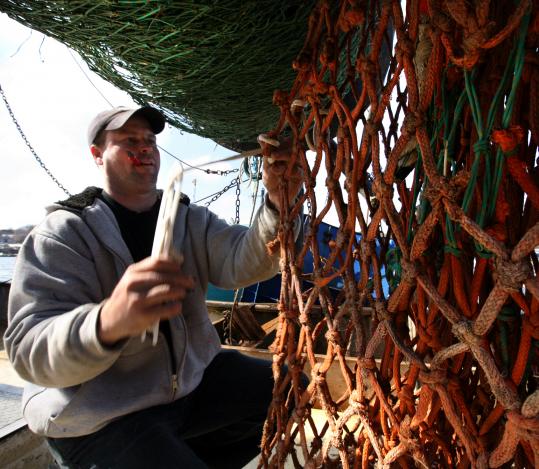
Radio 4 profiling their success in east-coast US today...
Bit like a veggie box - but for fish. You get local fish, in season. Good for fishing industry, and for consumers.
There were noises from the Transition Town group in the East Neuk of Fife that they would be setting up something similar last autumn. I look forward to investigating soon.
Radio 4 link:
http://www.bbc.co.uk/programmes/b00rvy23
Article from Boston Times:
http://www.boston.com/lifestyle/food/articles/2009/03/18/economy_of_scales/
Thursday, 8 April 2010
Should communities be paid for allowing waste plants?
This is a proposal from an Inquiry by a Parliamentary Committee, according to a story by green news site Ecowise this week.
One suggestion is that communities should be able to own the waste sites.
How about they follow the example of Remade in Brixton and look at making money from reducing their waste?
One suggestion is that communities should be able to own the waste sites.
How about they follow the example of Remade in Brixton and look at making money from reducing their waste?
Wednesday, 7 April 2010
Hyde Farm Group - going green and getting to know your neighbours
The inspiring work of Sue Sheehan's neighbourhood group 'Hyde Farm Climate Action Network' was profiled recently in The Guardian Society. I interviewed Sue for my book last autumn as she is closely involved with the work in Transition Town Brixton and is a part-time 'community champion' in Lambeth Council.
Sue says: A green scheme can provide a catalyst to bring people together as a group
Plastic Pollution
This recent story about health risks from plastics in the Indie highlights an issue Helen Lynn, Morag Parnell, and other wonderful campaigners have been working on without praise or publicity for many years. Congrats to all involved. Good to remember that there other environmental stories apart from climate change - and at the end of the day they are all linked...
Monday, 5 April 2010
Feasta - a collective thinking process
To continue thinking about the links between ecology and community... I was looking at the website of excellent Irish organisation Feasta, to feature in due course as one of the stories in my forthcoming book The Ecology of Community...
Feasta describes itself 'as a collective thinking process about the future' (feasta being an Irish word for future, taken from an early poem):
Cad a dheanfaimid feasta gan adhmad, ta deire na gcoilte air lar
What shall we do without wood, when all the forests are gone?
Their radical and sensible ideas include proposals on Cap and Share, a proposal to incentivise emitting less, and rewarding people, not companies in the process which has found currency (sorry) with the Irish Government and the UK's sustainable development commission.
Eminent economist Richard Douthwaite, who wrote the seminal titles The Growth Illusion and The Ecology of Money, is on the organisation's executive committe.
And it is of no coincidence, in my opinion, that it is such a non-hierarchical, participatory organisation, that is coming up with some of the most ground-breaking ideas to look at new systems of economics for a sustainable future.
Feasta describes itself 'as a collective thinking process about the future' (feasta being an Irish word for future, taken from an early poem):
Cad a dheanfaimid feasta gan adhmad, ta deire na gcoilte air lar
What shall we do without wood, when all the forests are gone?
Their radical and sensible ideas include proposals on Cap and Share, a proposal to incentivise emitting less, and rewarding people, not companies in the process which has found currency (sorry) with the Irish Government and the UK's sustainable development commission.
Eminent economist Richard Douthwaite, who wrote the seminal titles The Growth Illusion and The Ecology of Money, is on the organisation's executive committe.
And it is of no coincidence, in my opinion, that it is such a non-hierarchical, participatory organisation, that is coming up with some of the most ground-breaking ideas to look at new systems of economics for a sustainable future.
Subscribe to:
Posts (Atom)